

Ordered by 2pm, delivered the next day
Guaranteed product availability
Dispatch or collection

06/03/2026

Objektivadapter – leicht erklärt

So funktionieren Objektivadapter

Objektivadapter sind kleine, unscheinbare Zubehörteile – und trotzdem unglaublich praktisch. Sie ermöglichen es, Objektive unterschiedlicher Hersteller oder Systeme an einer Kamera zu verwenden, für die sie ursprünglich nicht gebaut wurden. Gerade in Zeiten spiegelloser Kameras gewinnen Objektivadapter immer mehr an Bedeutung. Doch was genau steckt dahinter, für wen sind sie sinnvoll und worauf sollte man achten? In diesem Artikel erklären wir das Thema Objektivadapter einfach und verständlich.


Wer nutzt Objektivadapter?

Objektivadapter werden vor allem von Fotografinnen und Fotografen genutzt, die flexibel bleiben möchten. Besonders beliebt sind sie bei:

  • Besitzer älterer Objektive aus Analogzeiten

  • Fotografen die auf ein neues Kamerasystem wechseln

  • Kreativen, die bewusst mit manueller Schärfe und Bildlook arbeiten

  • Videografen, die cineastische Objektive einsetzen

Kurz gesagt: Alle, die mehr aus ihrer vorhandenen Ausrüstung herausholen möchten, profitieren von Objektivadaptern.


Was ist ein Objektivadapter?

Ein Objektivadapter ist ein Verbindungsstück zwischen Objektiv und Kamera. Er gleicht die Unterschiede zwischen verschiedenen Bajonetten aus – also den mechanischen Anschlüssen von Objektiv und Kameragehäuse.

Es gibt zwei grundlegende Arten von Objektivadaptern:

  1. Mechanische Adapter

    • Keine Elektronik

    • Fokus und Blende werden manuell eingestellt

    • Sehr robust und preiswert

  2. Elektronische Adapter

    • Ăśbertragen Autofokus, Blendensteuerung und EXIF-Daten

    • Teurer und technisch komplexer

    • Ideal fĂĽr moderne Objektive

    • Autofokus zum teil nicht so schnell wie an Original Kamera


Warum sind Objektivadapter sinnvoll?

Der grösste Vorteil von Objektivadaptern ist Flexibilität. Statt Objektive zu verkaufen oder neu zu kaufen, lassen sich bestehende Linsen weiterverwenden. Das spart Geld und erhält oft einzigartige Bildcharaktere, die moderne Objektive nicht immer bieten.

Weitere GrĂĽnde fĂĽr den Einsatz:

  • Nachhaltigkeit durch Weiterverwendung bestehender AusrĂĽstung

  • Zugang zu besonderen Brennweiten oder Vintage-Looks

  • Grosse Auswahl an Objektiven ĂĽber Systemgrenzen hinweg

  • Kreative Kontrolle durch manuelles Arbeiten

Gerade spiegellose Kameras eignen sich besonders gut fĂĽr Adapter, da ihr kurzer Auflagemass den Einsatz verschiedenster Objektive erlaubt.


Wo kommen Objektivadapter zum Einsatz?

Objektivadapter werden in nahezu allen fotografischen Bereichen eingesetzt:

  • Porträtfotografie – fĂĽr weiches Bokeh und charakterstarke Bilder

  • Makrofotografie – alte Makroobjektive lassen sich hervorragend adaptieren

  • Landschaftsfotografie – manuelles Fokussieren ist hier oft kein Nachteil

  • Videografie – gleichmässige Fokuswege sind ideal fĂĽr Filmaufnahmen

Sie kommen sowohl im Studio als auch draussen zum Einsatz – überall dort, wo bewusst gearbeitet wird.


Wie funktioniert ein Objektivadapter?

Ein Objektivadapter stellt den korrekten Abstand zwischen Objektiv und Kamerasensor her. Dieser Abstand ist entscheidend, damit das Objektiv korrekt fokussieren kann – insbesondere bis unendlich.

Die Montage ist einfach:

  1. Adapter am Objektiv befestigen

  2. Objektiv samt Adapter an der Kamera ansetzen

  3. Kamera auf manuelle Bedienung einstellen (falls nötig)

Bei rein mechanischen Adaptern erfolgt die Steuerung von Fokus und Blende direkt am Objektiv. Die Kamera misst das Licht meist trotzdem korrekt – moderne Kameras kommen damit sehr gut zurecht.


Worauf sollte man achten?

Nicht jeder Adapter ist gleich gut. Achte besonders auf:

  • Passgenauigkeit – kein Spiel zwischen Objektiv und Kamera

  • Materialqualität – Metalladapter sind langlebiger

  • Kompatibilität – nicht jedes Objektiv unterstĂĽtzt jede Funktion

  • Lichtdichtheit – schlechte Adapter können Streulicht verursachen

Ein hochwertiger Adapter sorgt für Freude beim Fotografieren – ein billiger kann schnell Frust bringen.


Fazit

Objektivadapter sind ein einfaches, aber mächtiges Werkzeug. Sie eröffnen neue kreative Möglichkeiten, sparen Kosten und machen es möglich, alte Objektivschätze weiter zu nutzen. Besonders für experimentierfreudige Fotograf:innen sind sie eine echte Bereicherung.

Wer bereit ist, sich auf manuelle Bedienung einzulassen oder gezielt einen elektronischen Adapter wählt, wird mit einzigartigen Bildern belohnt.
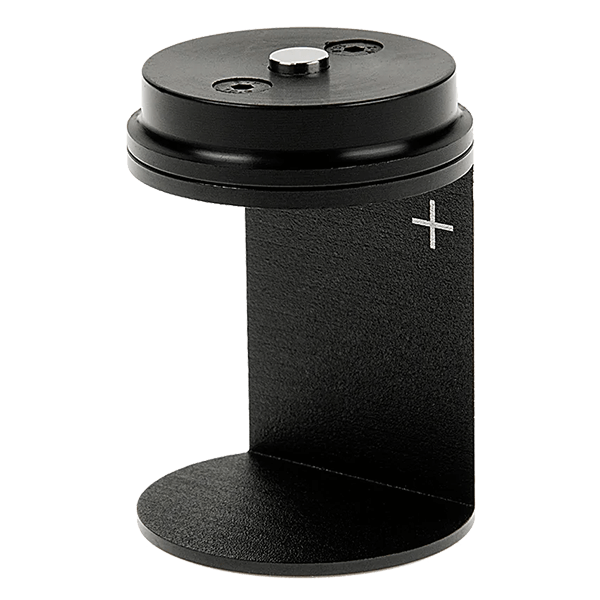
Fotodiox Battery Adapter for Hasselblad 500EL 500ELM 500ELX 553ELX
Battery adapter for Hasselblad cameras   The perfect solution for the expensive Hasselblad batteries is the Hasselblad 500EL/ELM/ELX 6 volt CR-P2 battery adapter. You can use up to two battery adapters in the Hasselblad battery housing. Hasselblad recommends two adapters for optimal performance. This adapter uses the CR-P2 low-voltage photo battery, which is safer than other high-voltage batteries, such as the 9-volt battery. It is made of one piece. There are no moving parts, such as loose cables, to deal with. The Hasselblad 500EL/ELM/ELX 6-volt CR-P2 adapter is made of strong, durable metal, with no breakable glass components.   Hasselblad Battery Alternative Save money with an easily accessible battery Approximately 200 shots per battery, two batteries per camera   Included in delivery:   1 x Battery Adapter HBV-CRP2 from Fotodiox.

CHF 42.50*
Temporarily Out of Stock
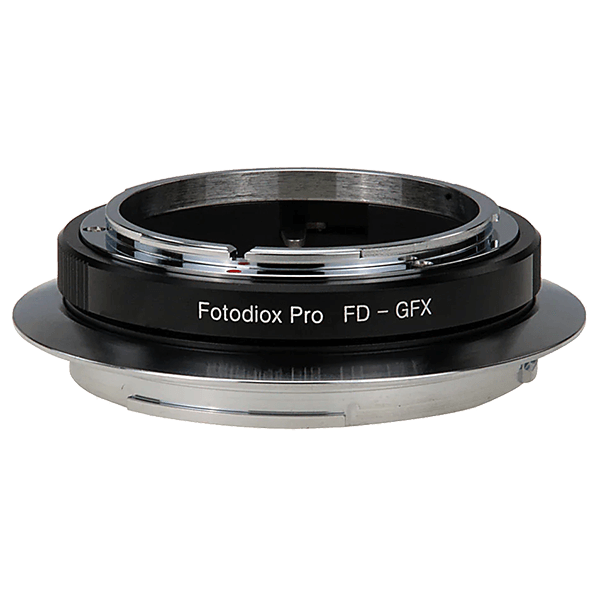
Fotodiox Canon FD to Fuji GFX G-Mount
Fotodiox Lens Adapter Canon FD - Fuji GFXWith this adapter you can use your beloved Canon FD lenses also on a modern Fujifilm with a G-mount.The following Fuji GFX cameras have this G-mount:Fujifilm GFX 50SFujifilm GFX 50RFujifilm GFX 100Fujifilm GFX 100SFujifilm GFX 50S IIAdapter for using Canon FD lenses on a Fuji GFX cameraThis adapter is used to use Canon FD lenses on a Fuji GFX camera. This makes this adapter a perfect tool for you as a system switch, you can continue to use your old Canon FD lenses on your new Fuji GFX camera. The adapter fits all cameras with a Fuji GFX mount.Manual focus and manual aperture selectionCanon FD lenses have a different flange focal distance than a Fuji GFX camera. This adapter compensates for this. There is no autofocus because the adapter does not establish an electronic connection between a Fuji GFX camera and a Canon FD lens. For this reason, the focus must be adjusted manually on the lens. The same applies to the aperture.Adapted Canon FD lenses can be used in the camera modes M, Aperture priority and Video.Canon FD lenses adapted to Fuji GFX cameras can be used in M and Aperture priority modes. In M mode, you choose the exposure time yourself. This is set with the corresponding dial on the camera. In aperture priority mode, the camera selects the appropriate exposure time. Last but not least, you only have to release the shutter. If you also want to film with the Fuji GFX, you can do that with the adapted lens. Made of anodized aluminum and chrome-plated brass - precisely manufactured and very stableThis lens adapter is made of anodized aluminum. It is very precisely manufactured so that it fits smoothly into the bayonet mount of a compatible camera. The adapter is a secure connection between camera and lens. And thanks to its good stability, using heavier lenses is not a problem.The advantages at a glance:Use of Canon FD lenses on cameras with Fuji G-bayonet mountConnection purely mechanical, no electronic data transferFocusing to infinity is possible without any problemsvery precise and stable workFor the technicians:Connection camera side: Fuji G-mountLens connection: Canon FDData transfer: NoMaterial: Aluminum (anodized) Brass (chrome plated)Note: On your Fujifilm camera you have to deactivate a shutter release lock first, so that the camera can be released without a recognized lens. You can find this setting in the following location:Menu > Setup > Buttons/Wheel Settings > Shooting without Lens > On.You can also find more information in the Fuji GFX user manual.Scope of delivery: 1 x Lens adapter Canon FD to Fuji GFX

CHF 119.00*
Only 3 available
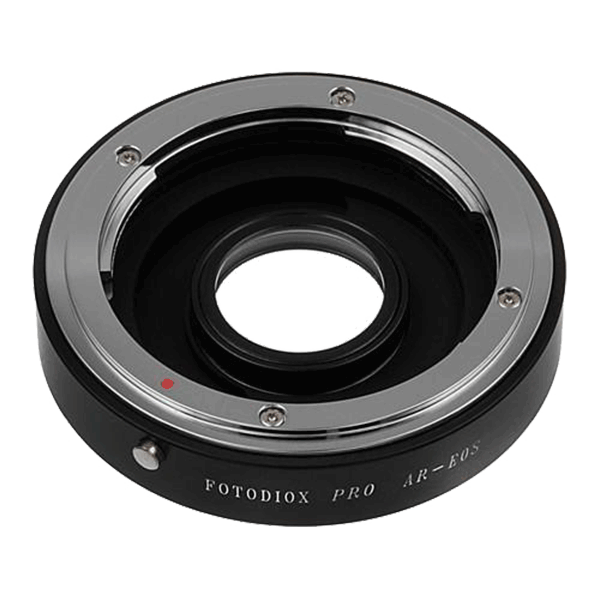
Fotodiox lens adapter Konica Auto-Reflex AR lenses - Canon EOS front
Fotodiox lens adapter Konica Auto-Reflex AR lenses - Canon EOS
Fotodiox lens adapter Konica Auto-Reflex AR lenses - Canon EOS   This sturdy, precision-manufactured adapter ring allows Konica Auto-Reflex AR lenses to be attached to Canon EOS cameras.The adapter compensates for the difference in support mass between camera and lens, so you can easily focus to infinity.However, both the sharpness and the aperture must be adjusted manually on the lens.The appropriate exposure time can either be selected manually on the camera in M mode or it is calculated by the camera in Aperture Priority mode. Technical features: Material: Aluminium   Hint: For some camera models, you must select the "Activate" option in the "Settings/trigger without lens" menu, otherwise the camera will not trigger. EOS lenses usually do not have an aperture ring. Photography is therefore only possible with an open aperture.

CHF 73.40*
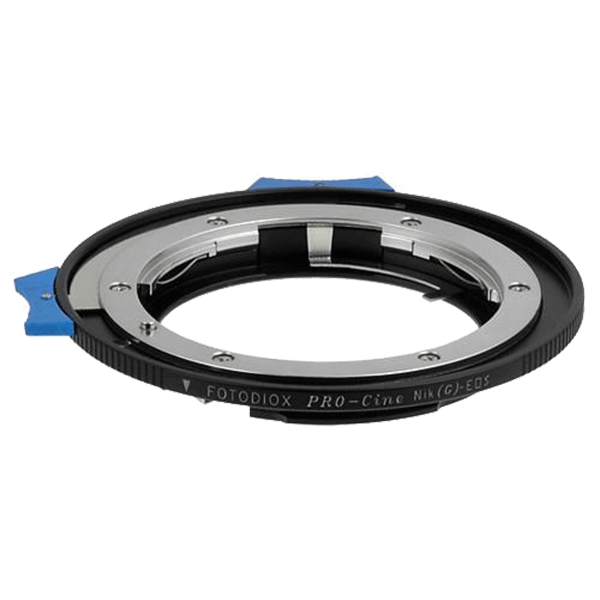
Fotodiox lens adapter Nikon F Mount G-Type to Canon EF
Fotodiox lens adapter Nikon F Mount G-Type to Canon EFAdapter for Nikon Nikkor F Mount G-Type lens to Canon cameras with EF or EF-S Mount.Sturdy, precision-machined adapter ring for attaching Nikon Nikkor F Mount G-Type lens to Canon cameras with EF or EF-S Mount. The adapter compensates for the flange focal distance difference between camera and lens, so you can easily focus to infinity. However, the focus as well as the aperture must be adjusted manually on the lens. The appropriate exposure time can be selected manually on the camera in M mode.The aperture on G-type lenses can be adjusted from the adapter. The matching rear cap for the EF mount can be found here.Technical details:Material: aluminum (anodized), brass (chrome-plated).Scope of delivery:1 x Lens adapter Nikon F and G-type lenses to Canon EF or EF-S mount

CHF 65.00*
Only 1 available
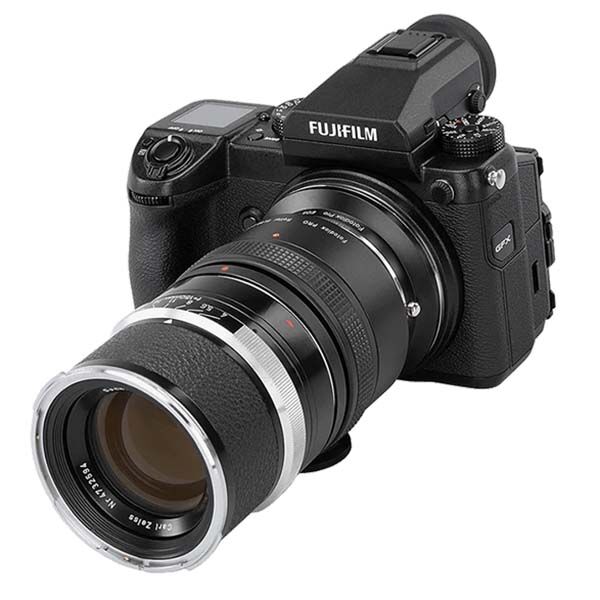
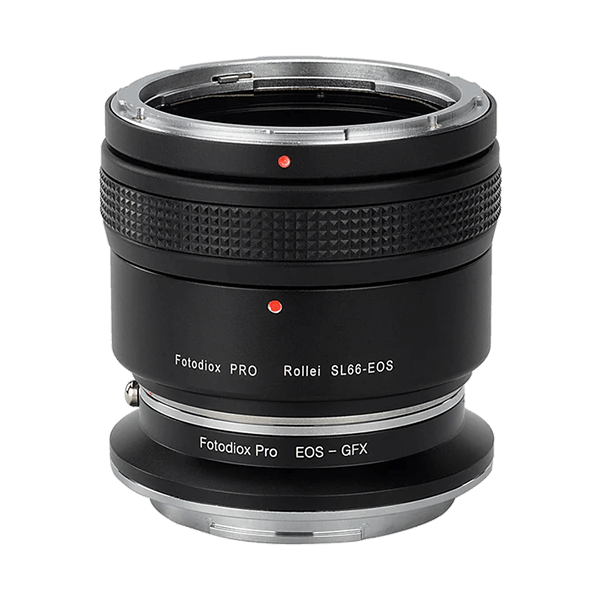
Fotodiox Objetkivadapter Rolleiflex SL66 auf Fujifilm GFX HooverFotodiox lens adapter Rolleiflex SL66 to Fujifilm GFX
Fotodiox lens adapter Rolleiflex SL66 to Fujifilm GFX
Fotodiox Lens Adapter Rolleiflex SL66 on Fujifilm GFX This adapter is designed to connect Rolleiflex SL66 series lenses and Canon EOS (EF/EF-S) D/SLR lenses to Fujifilm G-Mount GFX mirrorless digital cameras. With this adapter, you can open up new horizons in image creation by transferring the characteristic aesthetics of your favourite lenses to the advanced sensors of the GFX series. Key features of this lens adapter Dual adapter functionality: Combines the use of Rolleiflex SL66 and Canon EOS (EF/EF-S) lenses on Fujifilm G-mount GFX cameras. Precise fit: Ensures a solid connection with no play, ensuring stability and reliability. High-quality workmanship: Made of sturdy metal with chrome-plated brass connectors for durability and a secure fit. Infinite focusing: Guarantees the ability to focus to infinity or beyond, which is essential for landscape and architectural photography. Manual control: Enables manual adjustment of aperture and focus, giving you full creative control. Specifications Compatible lenses: Rolleiflex SL66 series lenses and Canon EOS (EF/EF-S) D/SLR lenses. Camera bayonet: Fujifilm G-mount GFX mirrorless digital cameras. Material: High-quality metal construction with chrome-plated brass connectors. Focusing: Manual focusing with infinity focus or beyond. Aperture control: Manual aperture control (depending on lens design). Dimensions: Precision machined for a perfect fit without adjustments. Weight: Robust yet lightweight for comfortable handling. Contents 1x Fotodiox Pro dual adapter for Rolleiflex SL66 and Canon EOS (EF/EF-S) lenses on Fujifilm G-mount GFX cameras. 1x protective cap for the lens side of the adapter. 1x protective cap for the camera side of the adapter. 1x user manual with important usage and care instructions. Immerse yourself in a new dimension of photography and discover the endless possibilities this adapter offers you. Experience the perfect symbiosis of classic lens art and modern camera technology.

CHF 299.00*
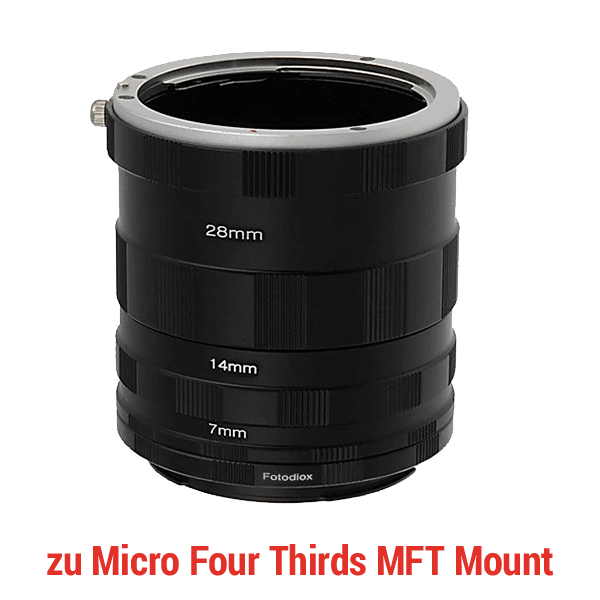
Fotodiox Macro Extension Tube Set for Micro Four Thirds MFT
Fotodiox Macro Extension Tube Set for Micro Four Thirds MFTMacro intermediate rings increase the imaging scaleThe macro extension rings enable macro photography with analog and digital Olympus cameras and lenses with Olympus Micro Four Thirds MFT M4/3 mount. They are available in lengths of 6, 14 and 27 millimeters, and the rings can be individually screwed together to increase the magnification. A camera adapter and a lens adapter are included for mounting on camera and lens.The extension rings are made of high-quality processed aluminum and do not transmit signals from the camera to the lens. Aperture and distance settings must therefore be made manually on the lens.Note: The rings do not transmit data between camera and lens. Lens AF and aperture control is therefore disabled. For macro photography, we recommend a tripod and, if necessary, an adjustment sled.All advantages at a glance:Made of aluminumOptical quality of the lens is preservedThree different lengthsCan be used individually or in combinationImage scale can be changed as desiredFor analog and digital cameras and lenses with Olympus Micro Four Thirds MFT M4/3 mountTechnical details:Material: aluminumRing lengths: 6, 14, 27 mmTotal length: 69 mm incl. adapterWeight: 50 gScope of delivery:3 x macro extension rings for Olympus Micro Four Thirds MFT M4/31 x camera adapter for Olympus1 x lens adapter for Olympus

CHF 32.00*
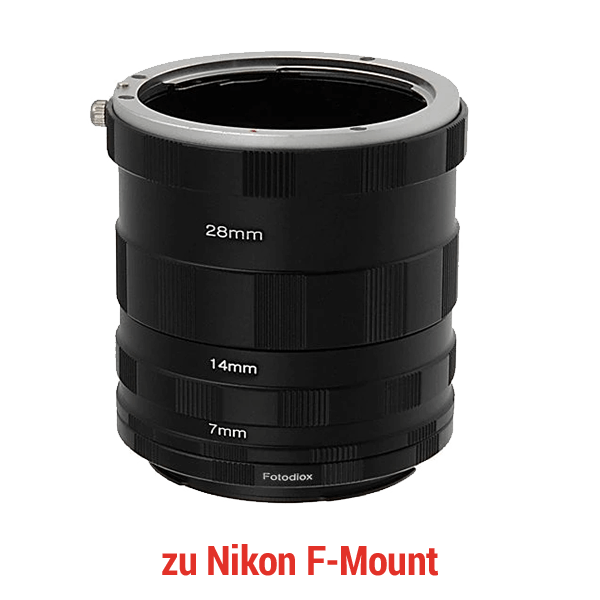
Fotodiox Macro Extension Tube Set for Nikon F
More magnification possibilities with macro extension rings The macro intermediate rings enable macro photography with analog and digital Nikon cameras and lenses with Nikon F bayonet. They are available in lengths of 6, 14 and 27 millimeters, and the rings can be individually screwed together to increase the magnification. A camera adapter and a lens adapter are included for mounting on the camera and lens.The extension rings are made of high-quality processed aluminum and do not transmit signals from the camera to the lens. Aperture and distance settings must therefore be made manually on the lens.Note: The rings do not transmit data between camera and lens. Lens AF and aperture control is therefore disabled. For macro photography, we recommend a tripod and, if necessary, an adjustment sled.All advantages at a glance:Made of aluminumOptical quality of the lens is preservedThree different lengthsCan be used individually or in combinationImage scale can be changed as desiredFor analog and digital Nikon cameras and lenses with Nikon F mountTechnical details:Material: aluminumRing lengths: 6, 14, 27 mmTotal length: 69 mm incl. adapterWeight: 50 gScope of delivery:3 x macro intermediate rings for Nikon lenses1 x camera adapter for Nikon1 x lens adapter for Nikon

CHF 28.00*
Only 3 available
%
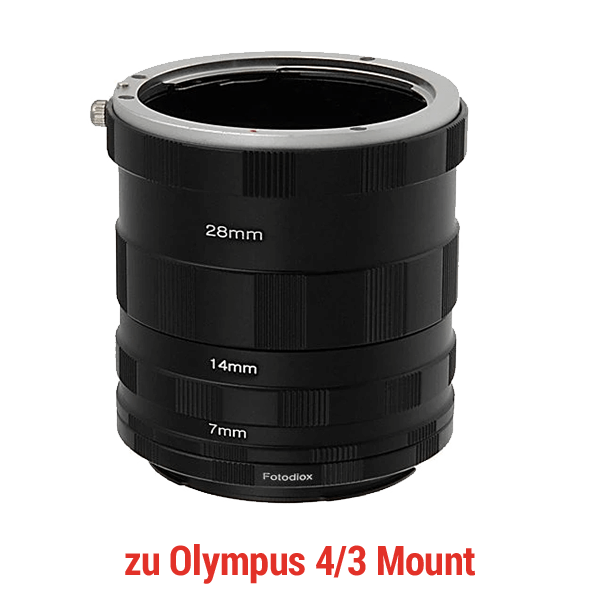
Fotodiox Macro Extension Tube Set for Olympus 4/3 OM4/3 4/3
Fotodiox Macro Extension Tube Set for Olympus 4/3 OM4/3  4/3 Macro extension rings increase the scale of reproduction The macro extension rings enable macro photography with analog and digital Olympus cameras and lenses with Olympus FourThirds mount. They are available in lengths of 6, 14 and 27 millimeters, and the rings can be individually screwed together to increase the magnification. A camera adapter and a lens adapter are included for mounting on camera and lens.The extension rings are made of high-quality processed aluminum and do not transmit signals from the camera to the lens. Aperture and distance settings must therefore be made manually on the lens. Note: The rings do not transmit data between camera and lens. Lens AF and aperture control is therefore disabled. For macro photography, we recommend a tripod and, if necessary, an adjustment sled. All advantages at a glance: Made of aluminumOptical quality of the lens is preservedThree different lengthsCan be used individually or in combinationImage scale can be changed as desiredFor analog and digital cameras and lenses with Olympus FourThirds mount Technical details: Material: aluminumRing lengths: 6, 14, 27 mmTotal length: 69 mm incl. adapterWeight: 50 g Scope of delivery: 3 x macro extension rings for Olympus FourThirds1 x camera adapter for Olympus1 x lens adapter for Olympus  

CHF 18.00* CHF 25.10* (28.29% saved)
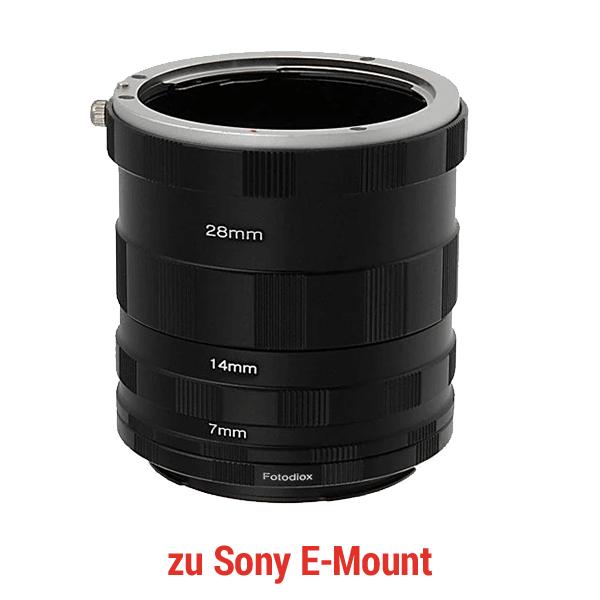
Fotodiox Macro Extension Tube Set for Sony E-Mount
More magnification possibilities with macro extension rings The macro extension rings enable macro photography with digital Sony cameras and lenses with an E bayonet. They are available in lengths of 6, 14 and 27 millimeters, and the rings can be individually screwed together to increase the magnification. A camera adapter and a lens adapter are included for mounting on the camera and lens.The extension rings are made of high-quality processed aluminum and do not transmit signals from the camera to the lens. Aperture and distance settings must therefore be made manually on the lens. Note: The rings do not transmit any data between camera and lens. The lens AF is therefore deactivated. For macro photography, we recommend a tripod and, if necessary, an adjustment slide. All advantages at a glance: Made of aluminumOptical quality of the lens is preservedThree different lengthsCan be used individually or in combinationMagnification scale can be changed as desiredFor digital Sony cameras and lenses E-bayonet Technical details: Material: aluminumRing lengths: 6, 14, 27 mmTotal length: 69 mm incl. adapterWeight: 50 g Scope of delivery: 3 x macro extension rings for Sony E-mount lenses1 x camera adapter for Sony1 x lens adapter for Sony  

CHF 32.00*
Only 2 available
%
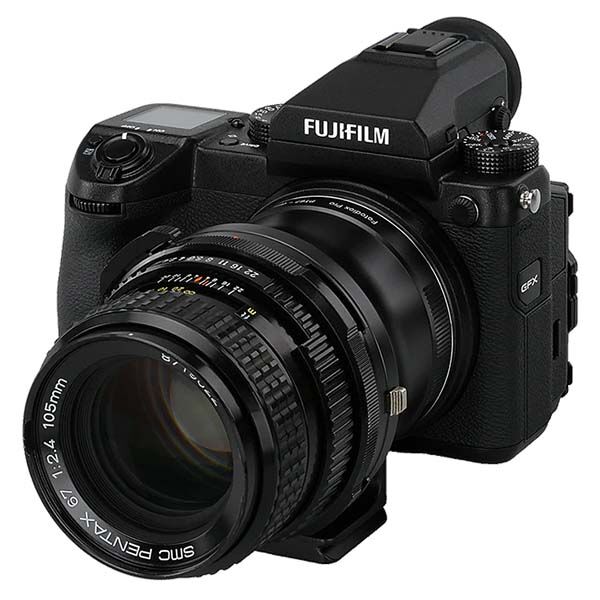
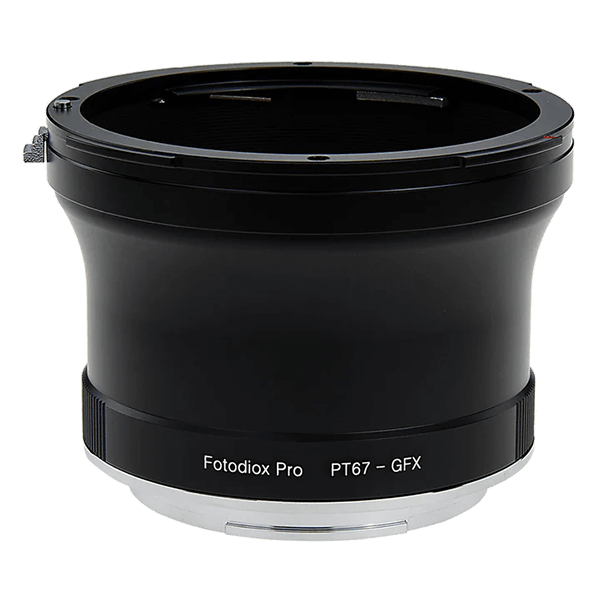
Objektivadapter Pentax PK67 an Fujifilm GFX Kameras von Fotodiox HooverFotodiox Pentax PK67 Lens Adapter for Fujifilm GFX Cameras
Fotodiox Pentax PK67 Lens Adapter for Fujifilm GFX Cameras
Fotodiox Pentax PK67 Lens Adapter for Fujifilm GFX Cameras Would you like to continue using your beloved Pentax 67 lenses even though you have switched to the Fujifilm GFX system? This is exactly where the Fotodiox Pro Lens Mount Adapter - Pentax 67 to Fujifilm GFX comes into play. Key features Seamless compatibility: Easily connects Pentax 67 lenses to Fujifilm GFX cameras. Sturdy construction: Made of high-quality anodized aluminum for maximum durability. Precision Design: Precision fit with no wobble – for stable and secure mounting. Manual Focus: Full creative control over focus and aperture. Technical Data Material: Anodized aluminum alloy body Compatibility: Pentax 67 lenses on Fujifilm GFX mount Focus: Manual focus (no autofocus or electronic aperture control) Dimensions: Compact and lightweight for mobile shooting Weight: Optimized for balance and stability Contents 1x Fotodiox Pro Adapter (Pentax 67 to Fujifilm GFX) With this adapter, you not only expand your photographic repertoire – you open the door to a new world of image design. Ready to unleash your creativity in a new way?

CHF 139.00* CHF 153.00* (9.15% saved)