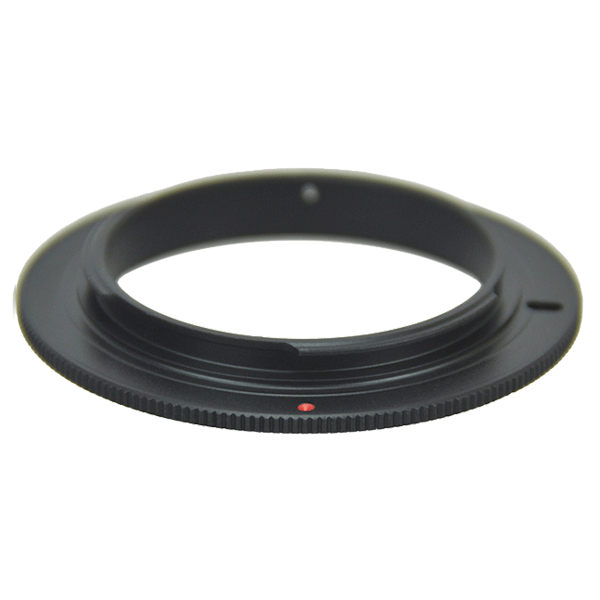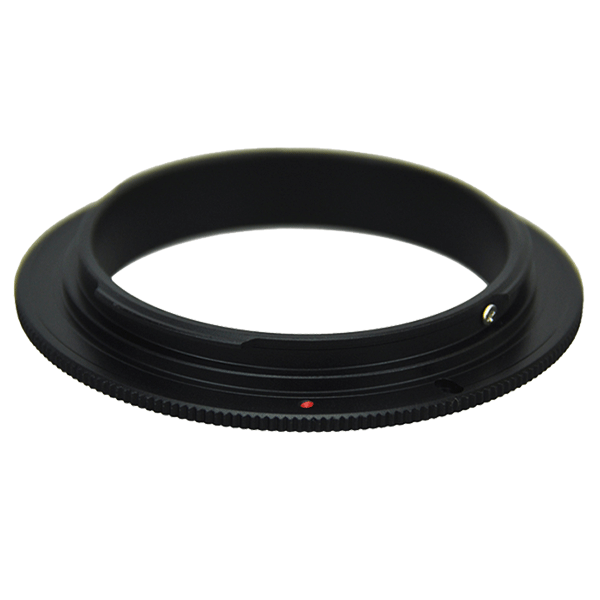


Reverse rings Retroring
There are different names for the retroring that can be found on the web. Reverse rings are also called retroring or retroadapter. The principle is simple: you take a lens and turn it around. Turned this way, it is either attached directly to the camera or combined with other lenses or with extension rings and placed in front of the extension rings or lenses. Due to the design, the focal plane is closer at the back of the lens than at the front. By turning the lens, you can get much closer to the object. Reversing rings therefore allow image scales that are significantly larger than 1:1 and you thus enter the realm of microphotography.
Compared to close-up lenses, the biggest advantage is certainly that a reversing ring does not interfere with the optical calculation of the lens, since no further optical elements are brought into the optical path. As long as there are suitable reversing rings, you are no longer dependent on the bayonet or the lens brand. Almost any lens of any manufacturer can be mounted with a reversing ring. Lenses in retro position can be combined with other accessories (extension rings or bellows) without major problems. However, not every lens really makes sense.
By mounting the lens "upside down", you will also incur some minor disadvantages. Since the bayonet is now on the front side, the lens has no more contact with the camera or with the camera control. Exposure metering is only possible via the working aperture metering, autofocus no longer works and the aperture has to be set manually (lenses without aperture ring are therefore only suitable for the retro position to a very limited extent). There are, however, special solutions that remedy this problem and which we will also present to you in this article.
Long focal lengths (telephoto) have a narrow angle of view. The rear lens (pupil) therefore needs a greater distance from the sensor than lenses with a large angle of view (wide angle), whose pupil is much closer to the image sensor. In general, therefore, the following order applies for the suitability as a retro lens: wide angle - normal - telephoto. Wide-angle lenses permit the largest imaging scales. Only extremely short focal lengths (super wide-angle) are out of the question, because they usually have very large and curved front lenses and therefore there is no filter thread to attach such lenses to the camera in retro position. By the way, a good start are the classic KIT lenses (often in the focal length range 18 - 55 mm).
But also old lenses, which you can buy for a few francs at the flea market or on ebay, are well suited, as long as they have a filter thread. Especially old lenses still have a mechanically adjustable aperture by means of an aperture ring.