
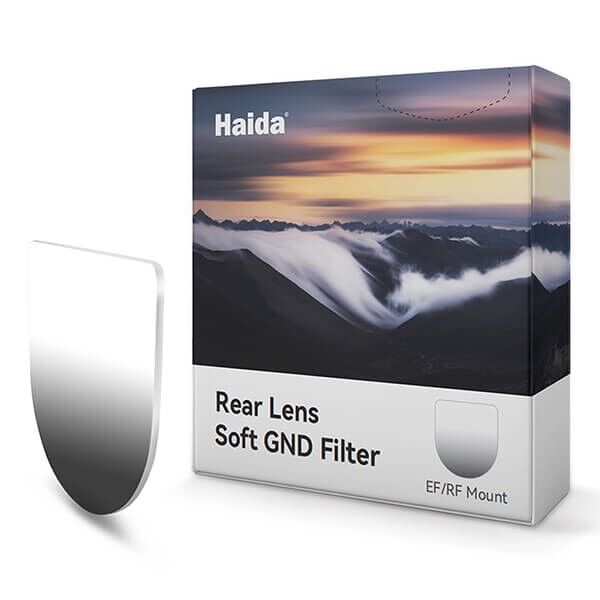
Haida Rear Lens Soft GND 0.9 for Canon EF and RF

CHF 35.00*
Ready for immediate shipment, arrival in: 1-2 Working Days
✅ Pick up after order in Langnau possible
- own warehouse
- fast shipping
- shipping with Swiss Post
- pick-up after order possible





Many Canon camera bags contain an ultra-wide-angle lens that has been performing reliably for years: a 16-35, an 11-24, or a fisheye. What these lenses lack is a filter thread, because the front element is curved. As a result, when shooting against a bright sky over a dark foreground, you’re left with a choice between an overexposed sky and an underexposed foreground. This graduated filter attaches to the back of the lens and solves the problem right where there’s space.
- Soft gray gradient with 3 f-stops, density 0.9
- Sits behind the lens; no holder in front of the front element
- No vignetting, unlike that caused by front-mounted filters
- The gradient sits securely; you can compose your shot around it
- For Canon EF and RF, also compatible with EF lenses on RF bodies
- Requires a compatible adapter; not included
The filter is mounted at the rear, not the front
For lenses without a filter thread
An 11-24mm or a fisheye lens cannot accept a screw-on filter at the front because the front element protrudes too far. Attachment systems are available, but they are large, expensive, and require their own space in your bag. Here, the filter is positioned at the rear of the lens and doesn’t add any bulk on the outside.
No vignetting
Filters mounted in front of the lens quickly intrude into the image at extreme focal lengths and darken the corners. Because the filter is positioned behind the lens elements, this doesn’t happen at all—not even at 11 or 14 millimeters.
Three f-stops of soft gradation
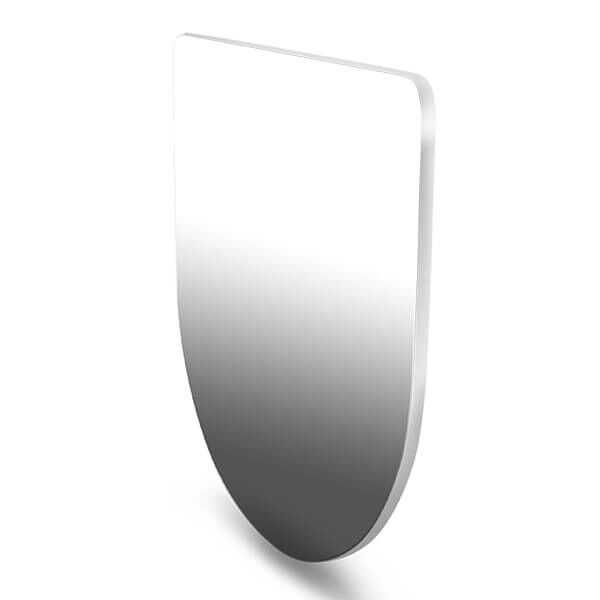
Density 0.9 corresponds to three f-stops. “Soft” means that the transition from dark to clear is gradual rather than occurring along a sharp edge. For landscapes with trees, mountains, or buildings on the horizon, this is the option that doesn’t give itself away as a line in the image.
Here’s what it looks like in everyday use
Sunset over a dark landscape
The sky is blown out, the foreground is underexposed, and you can’t capture both in a single shot. With a three-stop gradient, you can bring the sky back without sacrificing the ground.
Fisheye with sky in the frame
With an 8–15mm or a 15mm fisheye lens, you almost always have a lot of sky in the frame, and it’s almost always too bright. You can’t add anything in the foreground, but you can in the background.
Architecture from below
When you shoot upward with a wide-angle lens, you’ll have a bright sky above a dark facade. The same gradient brings both areas within a range that the sensor can capture.
What you should know before ordering
The gradient cannot be moved
Unlike with a front-mounted filter, the transition is fixed in one place. You can’t move it to the horizon; instead, you have to position the horizon where the gradient is. This helps determine your composition. If you want to set the dividing line freely—for example, for a very low or very high horizon—you’ll need an attachment system. For the same reason, changing it isn’t something you can do in a snap: you’ll need to remove the lens to do so.
The adapter is not included
The filter alone isn’t enough; you’ll also need the right adapter for your lens. You can find it right here with the product—order it at the same time. If you’re unsure which one is compatible with your lens, give us a call before you order.
It’s only compatible with certain lenses
The filter is designed for ultra-wide-angle and fisheye lenses with a Canon EF or RF mount that have a rear filter mount provided by the manufacturer. These include, among others, the Canon EF 11-24mm f/4L, 16-35mm f/2.8L, 17-35mm f/2.8L, 17-40mm f/4L, 14mm f/2.8L, 15mm f/2.8 Fisheye, and 8-15mm f/4L Fisheye, as well as the Tamron SP 15-30mm f/2.8 (both generations), Sigma 14-24mm f/2.8 Art, 12-24mm f/4 Art, and 14mm f/1.8 Art, and the Samyang AF 14mm f/2.8 RF. This list is not exhaustive. Ask us if your lens isn’t listed. If your EF lens is mounted on a Canon mirrorless body via an adapter, the filter will also work. It sits inside the mount, with the adapter mounted behind it.
Technical Details at a Glance
- Type: Soft GND, soft gray gradient filter
- Density: 0.9
- Effect: 3 f-stops
- Gradient: soft, fixed position
- Position: behind the lens
- Mount: Canon EF and RF, also compatible with mirrorless bodies via adapter
- Adapter: required, not included
Package Contents
- 1 x Soft GND 0.9 filter
- 1 x protective and carrying case
The manufacturer Haida specializes in the production of high quality filters for various uses in photography. Haida filters are all made of optical glass. Haida produces filter holders as well as screw filters. The filter holders for plug-in filters are available in the width of 100 mm and 150 mm in our assortment. There are also matching Haida adapter rings in different sizes. Of course, Haid also manufactures ND and GND filters in various dimensions. The Haida ND filters are mainly used in landscape photography. When it comes to coating, the Haida company uses the NanoPro MC designation for multi-coated surfaces, with the NanoPro series being the most current version. Haida systems are available for all sizes of lenses from different manufacturers. The kit Haida M10 II system for 100 mm should not be missing on any photographer's wish list. Haida filters can be used especially well for shooting with water. Haida products do not need to be afraid of comparison with other products such as those from Lee. The ND or gray filters are available in different strengths. So that not too much time is lost in post-processing, the filters from Haid are color-neutral. With the Haida M10 series, you can make perfect long exposures. The corresponding 100 mm graduated filters can be mounted high or low in the filter holder. For ultra-wide angles, Haida also has a corresponding solution in its range, namely the M15 system. With a width of 150 mm, these filters cover a wider angle of view compared to the 100 mm. If such an ultra-wide angle is on your wish list, please be sure to note the Haida M15, there are various adapters for the most diverse combinations. Haida also has rear lens filters, these mount in the lens bayonet and are available in various strengths. Simply put, you can find the right filter for every application in Haida's range. Whether these are then used in the city or in the countryside, it does not matter. The products are also accompanied by brochures or manuals in English that give an overview of the entire range.